
Recent Posts




What purpose do you have in life if you're an ince...




































Silly

xtUnRp
No.550798
>reeeeeee we hate pakistan
>regularly do bants and rehearsals with them at attari
We don't see such stuff between north and south korea. This is just pointless.
VJkt8k
No.550802
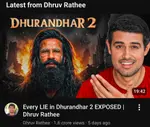
To understand the gravity of Jaskirat's final walk into the darkness of Pathankot, one must first reconcile the dual lives he has led. This transition from a human being with a lineage to a weapon of the state is the central tragedy of the narrative, and the final scene acts as the terminal point of that transformation, where the weapon realizes it can no longer fit back into the scabbard. The sequence begins with Jaskirat’s arrival in Pathankot —a liminal space that mirrors Jaskirat’s own internal state. Having been extracted from Pakistan by Ajay Sanyal in a mission that pushed the boundaries of international law, Jaskirat is physically broken but ostensibly free. However, the film posits that "freedom" for a deep-cover asset is an oxymoron. As he stands at a distance, shrouded by the gloaming of a Punjabi evening, the cinematography utilizes long lenses to compress the space between Jaskirat and his family home, creating a visual paradox where he is close enough to see the flickering light of the television inside but remains light-years away from the life it represents. His mother and sister, Jasleen, are depicted in a state of domestic normalcy—folding clothes, sharing a meal—that feels alien and almost sacred through Jaskirat’s eyes. This voyeurism is not born of a desire to return, but rather a realization of what has been preserved by his absence. The narrative weight of the entire Dhurandhar saga rests on the idea that the peace enjoyed by the civilian population is bought with the souls of men like Jaskirat, who must commit atrocities so that their families never have to know such things exist. He chooses to become a "ghost" not because he lacks love for his family, but because he possesses it in its most sacrificial form. To step into the light and embrace his mother would be to bring the shadow of "Hamza" into her home. He is a man who has lived a lie for so long that the truth has become a weapon; his return would necessitate explanations of where he has been, the blood on his hands, and the enemies he has made. The closing of the front gate by his mother is the film's most potent symbol—a definitive, mechanical click that seals Jaskirat out of the Garden of Eden. It represents the "Sealed Gate" of his past; the mother protects the home from the night, unaware that the very thing she fears—the darkness—is her son, and the very thing that protected her is his willingness to stay in that darkness. A significant segment of the audience has theorized that Jaskirat did not survive the brutal interrogation in the third act and that the Pathankot sequence is a post-mortal projection—a "bardo" state where he witnesses the world moving on without him. Whether he is biologically alive is almost secondary to the fact that he is socially and spiritually dead. He is a man who has fulfilled his purpose; in the cold logic of the state, he is a spent cartridge. His walk away from the house, as the camera pulls back into a wide, lonely shot of the Pathankot streets, signifies the birth of a new kind of protagonist: the wandering Ronin of the intelligence world, a man who belongs to no nation and no family, existing only in the "in-between" of history. Ultimately, Dhurandhar 2 concludes as a critique of the hero myth. It suggests that the true heroes of national security are not the ones who return to medals and parades, but the ones who disappear into the crowd, unthanked and unrecognized. Jaskirat’s tear is not one of regret for his mission, but of mourning for the boy he used to be. The film ends on a note of profound, existential loneliness, leaving the audience to grapple with the reality that the safety of the collective often requires the total destruction of the individual's identity. Jaskirat Singh Rangi dies so that the "asset" can live, and then the asset disappears so that the family can survive. It is a cycle of sacrifice that leaves the protagonist as the ultimate "dhurandhar".
xtUnRp
No.550803
>>550802
Blaady
yaGOSd
No.550804
>>550798(OP)
>No saar. How can you do something differently. You must be the same as others.
7vrER2
No.550809
>>550798(OP)
it seems kinda cool. life is too short to be always about work and shit. i hate society and people like op