















































9tozFL
No.1651
>>1650
hey blud are like some kind of indian guy who lives in the uk

dLgsif
No.1652
>>1650
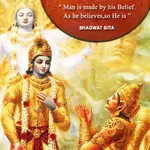
>The phrase "Man is made by his belief. As he believes, so he is," is a famous quote often attributed to the Bhagavad Gita, emphasizing that our inner convictions and mindset fundamentally shape our character, reality, and destiny, essentially meaning our thoughts and faith define who we become. While often quoted as a direct line from the scripture, it's a summary of ideas found in Chapter 17, Verse 3, which speaks of faith conforming to one's nature (Shraddha), suggesting our beliefs (sattvik, rajasic, or tamasic) dictate our actions and essence.
>Meaning of the Quote
>Self-Creation: Your beliefs aren't just abstract ideas; they are the building blocks of your identity and actions, making you what you truly believe yourself to be.
>Power of Mindset: Positive beliefs foster positive outcomes, while negative or limited beliefs lead to corresponding limitations or sadness.
>Core of Reality: The quote reflects a philosophical idea that one's inner state (faith, or shraddha) is the core of their being, influencing their entire existence.
>Origin and Context
>Bhagavad Gita (Ch 17, Verse 3): The original Sanskrit verse says, "The faith of all humans conforms to the nature of their mind. All people possess faith, and whatever the nature of their faith, that is verily what they are," highlighting how different types of faith (pure, passionate, or ignorant) align with one's disposition (guna).
>Widespread Adoption: The simplified English phrasing became popular, attributed to the Gita or sometimes to thinkers like Goethe, to convey this powerful concept.
dLgsif
No.1653

>>1651
just a reader, it's a good story. I don't think most Indians know what it means or how to convey it properly.
dLgsif
No.1674

>>1653
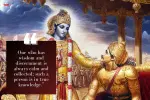
In Bhagavad Gita and the Mahabharata, Arjuna is presented as a person who does not know the answers and in BG he evens starts as scared and depressed due to the inevitable war he is facing. This is unique amongst religions where the protagonist is defined by "not knowing" instead of as a prophet although Indians tend to lionize him as a pivotal figure in Indian history although doing this for someone who does not know the answers carries its own risks and does a lot to explain the Indian temperament. He is justifiably despondent due to wanting to avoid war with his cousins, from a moral standpoint Arjuna is correct by not wanting to participate. It is Krishna who provides the guidance yet it is not Krishna who does anything, it is Arjuna. This follows the concept of "advaita" (non-duality) where it is not clear who is doing what, who has the knowledge or is ignorant, who is good or bad. Krishna says action also has a place when it is a duty and righteous and all have a place in God's will as it all sinks into Brahman.
The Kauravas believe they have valid grievances against the Pandavas. Their leader Duryodhana is presented as the villain although by the end both he and Yudhishthira as the leaders of both families go to heaven in the Himalayas as they fulfilled their duties and kept the wheel spinning and the cycle going to its fitting end.
From a western and Christian perspective, this kind of moral ambiguity and thoughtless duty framed as righteousness could be interpreted as wrong and corrupt and leads to a lot of perceived problems in India, but it is very Indian. There is no intercession between the individual and God such as a prophet or messiah except perhaps Krishna message which mostly loops around in circles but you are the one who is asking the questions about it.
dLgsif
No.1675

>>1674
The game "Shadow of the Colossus" has a similar theme which Japanese media tends to do due to their similar Dharmic culture but being Buddhist instead of Vedic there is still a vagueness on their own stance on it, is it good or bad? An Indian would say anything Hindu is good a Buddhist would say it isn't either. In the story the protagonist has to defeat giants in a dead world for no apparent reason, they even elicit sympathy when killed framing you as a a potential antagonist, but the reasons you are doing it are not apparent until the end. Throughout the journey you are alone with yourself until one of the giants ae encountered providing a fitting metaphor for the battle with oneself.
This is in contrast to a series like Zelda or western media in general which take a more Christian and Abrahamic stance, Good and Evil are clearly defined with you on the side of Good and the price of inaction against Evil is death, of yourself and everything Good in the world. Zelda also takes place in a desolate world but this is due to the presence of Evil, not the Self. Islam has a similar worldview although to a Christian its values of Good tend to be different, even inverted. I don't know whether Islam sees Christian like this too, but Hindus would see them as both right and wrong in their "advaitic" philosophy.
dLgsif
No.1676
>>1675
Essentially, Krishna is telling Arjuna to "do the needful"
Ta6O7d
No.1690
>>1647(OP)
gita is amazing i will be careful of dummies like him tho, watch Osho or Dr. alok kanoja ( healthy gamer gg ) or even satay speak than alan watts.